Adam’s Take on Episode 12: “In the Hands of the Prophets”
All too often, the intersection of politics and religion is painted with blood. In the United States, recent election cycles have revealed a disturbing cross-section of Christian evangelicals propagating ideas of white nationalism and parroting misguided banalities of America’s so-called “divine privilege.” The response of those who do not share such convictions has been fierce, and rightfully so. Unfortunately, the national discourse has devolved into an “us vs them” mindset. While it is convenient to assume we all exist in such dichotomies as “irreligious vs religious” or “progressive vs conservative”, life is seldom so black-and-white.
While it is convenient to assume we all exist in such dichotomies as “irreligious vs religious” or “progressive vs conservative”, life is seldom so black-and-white.
Navigating the aforementioned convergence of politics and religion has been a lonely venture of late. As a man of faith and, reluctantly, a leader,— though I like to think of myself as unimportant and insignificant in this regard— I have found myself at odds with many faith leaders. I have been out of step with others that— I had previously thought— shared my spiritual persuasions. I have been moved to grief over hypocrisy and inaction that have proven the culpability of the American idea of Christianity that is often far removed from the actual ideas of the Bible. Ashamed, I have found myself wrestling with questions and doubts.

The season one finale of Deep Space Nine, “In the Hands of the Prophets”, examines the supposed rivalry of science and faith; one is reminded of “Inherit the Wind” via a science-fiction lens. The charismatic Bajoran spiritual leader Vedek Winn (Louise Fletcher) espouses a philosophy of fundamentalist orthodoxy, teaching— in a roundabout way— that science is antithetical to religious belief. This brings her and her adherents into conflict with the more progressive ideas of the United Federation of Planets, epitomized by the school teacher Keiko O’Brien (Rosalind Chao). Of course, political machinations ensue, and people bleed and die for what they consider to be a “righteous cause.” Even aliens in the 24th century seem unable (or unwilling) to divorce their politics from their religion.
Though I am a man of faith, I strongly believe that your heart and your brain are meant to work together. On more than one occasion, I have been accused of being too “cerebral” for my own good, but I find that intellectualism is a complement to my faith rather than a threat. As much as I admire Søren Kierkegaard and Blaise Pascal, I consider fideism to be a woefully inadequate epistemological theory. In my worldview, human reason and the application of such (i.e. science) can work hand-in-hand with faith.
Furthermore, I do not see politics as a vehicle by which to advance religious beliefs. Instead, I find the intermingling of politics and Christianity to be a gross misappropriation of the actual idea of the Church and its service in the world. In the United States, political affiliation has become a sort of “litmus test” for the sincerity of one’s faith— this is a far cry from the indicator that Jesus used.1
Unfortunately, my belief that science and faith are compatible and that politics should be separate from religion is a minority voice that is silenced by the sensational Scopes Monkey Trials and effervescent Trumpisms that are much more public. I shudder to think that, when someone learns that I am a man of faith, they wrongfully assume I am a sort of Vedek Winn, committed to a lust for power by perpetuating fear and ignorance more so than any idea of faith. Worst of all, the “Vedek Winns” of the world block people from seeing actual faith ideas. As “Inherit the Wind” reminds us, “An idea is a greater monument than a cathedral.” People of faith are so quick to set aside ideas so that they might build grand cathedrals. In doing so, they don’t realize that they are sacrificing that which gives faith light by filtering its essence through thick stained-glass windows, simultaneously dimming and scattering the message with a prism of unnecessary designs that are opposed to the idea for which they originally built their cathedral. Once a monument to the idea, such cathedrals only serve to distract.
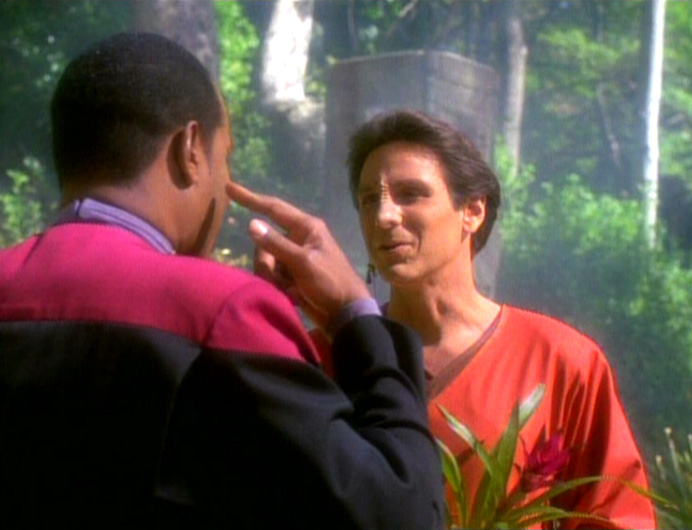
As the more progressive Bajoran spiritual leader, Vedek Bareil (Philip Anglim), tells Commander Sisko (Avery Brooks), “We’re all very good at conjuring up enough fear to justify whatever we want to do.” Whatever our idea, we have to be cautious that we do not build cathedrals that serve only to promote fear and ignorance.
1 “By this everyone will know that you are my disciples, if you love one another” (John 13:35).
Return to Jim’s Take: “Season finale reaches greatness with examination of facts vs beliefs”
Return to Rhonda’s Take: “A meditation on faith and politics rounds out first season”
Return to Ray’s Take: “It’s a Matter of Faith in Science”
Return to Matt’s Take: “Vedek Winn: Truly the worst!”
Return to Episode Logs or Episode 19 Guide
 Ponderings from the Promenade: A Journey through Star Trek Deep Space Nine
You must be logged in to post a comment.