
Rhonda’s Take on Episode 19: “In the hands of the Prophets”
I’ve never liked Keiko.
I had to get that out of the way upfront.
I’ve never liked Keiko, but in an argument about whose authority prevails in the classroom, I would want her on my side.
Let me dispense with an example of why I hate Keiko. In the opening scene of this episode, Miles and Keiko O’Brien are walking along the Promenade. Miles offers her a Jumja bar, but Keiko curls up the sides of her nose and declares it, “Too sweet!” Then, she harasses him about his praise of a fellow engineer. Even though she seems to drop the jealous wife haranguings as an act to keep him on his toes, her behavior is just wrong.
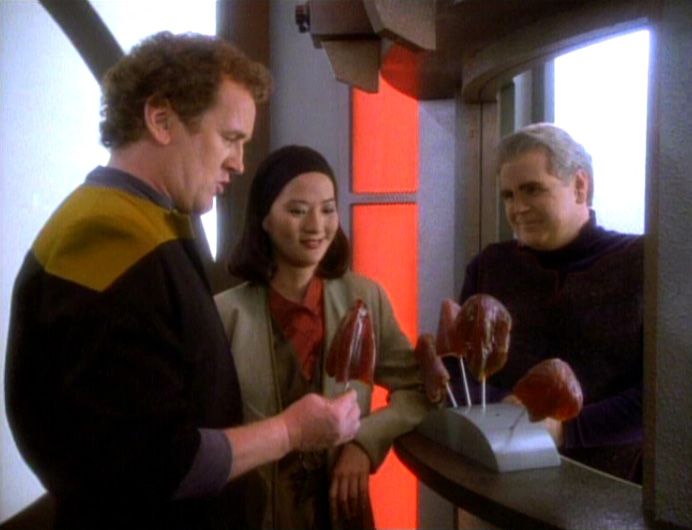
However, her prickliness pays dividends in this episode as she refuses to be cowed by Vedek Winn.
If you haven’t read every tidbit of information on Ponderings from the Promenade, you might not know that three of your Ponderers are teachers. The other three regular contributors might consider themselves educators in other ways: the director of a massage therapy school, a chaplain, and a student of the law. Therefore, “In the hands of the Prophets” is an episode that we all react strongly to, whether our first or fifth watching. When Keiko declares, “My responsibility is to expose my students to knowledge, not hide it from them,” we gave a collective “Amen! Preach it, sister!” from our respective, separate abodes.
We gave a collective “Amen! Preach it, Sister!” from our respective, separate abodes.
The title sounds like a religious verse, which can be interpreted as comfort—the guidance and safety of a Supreme Being—or as justification—our decisions are not our own, but those of the Supreme Being. Both of these interpretations are espoused during the episode as an argument of science versus religion unfolds on screen.
Does it matter that we learn Vedek Winn only stirred up the argument for political gain? No, because the harm has been done. Also, the political angle is one that seems to play out time and again throughout history, which bears its own analysis.
At this juncture, let’s consider the science versus religion argument as presented by each of our characters.
Keiko: She teaches “pure science” in the classroom
Winn: Science that ignores the Bajoran spiritual beliefs is blasphemy.
Kira: Science without spiritual context is a type of philosophy.
Sisko: The Federation is open to all philosophies.

Kira admits that there is not a satisfactory compromise and supports separating the school because Bajoran and Federation interests are often separate. This is not acceptable to Sisko, who sees the Federation’s role not simply as a firewall against the Cardassians retaking Bajor, but as a mentor bringing the planet into the larger universe.
Vedek Winn and Vedek Bareil are political and religious foils. Winn is Orthodox, fanatical, and power hungry. Bareil is modern, reserved, and peace seeking. Winn goes in for the Pah squeezing at every opportunity while Bareil would like to abolish the practice. It’s such a joyous moment when Winn reaches to squeeze his ear and he instead directs her hand into a palm squeeze. I think we all know who is going to win in this tussle because the good guys always suffer loss before any concessions are made. (What? Too cynical? I’m generally accused of being the optimist, but on this point, I’ve seen far too many dramas in fiction and in real life where the good guys don’t win.) I’m going to be pretty harsh in my interpretation of Winn’s actions, so I should recognize that Bareil isn’t wholly innocent. While his faith appears more genuine than Winn’s, he is willing to play politics. (Bareil: “The Prophets teach patience.” Sisko: “They also teach you politics.”) He is unwilling to arrange a meeting between Sisko and the Vedek assembly because the friendship might hurt his chances at becoming Kai. When the tides shift, he arrives at the station to help Sisko “clean it up.” Taking advantage of the violence, he preaches a need for tolerance and acceptance of new ideas and is greeted with cheers from the crowded Promenade.
As an AP Language and Composition teacher, I can’t help analyzing the argumentative approach that Winn takes. She’s superbly manipulative. She knows to always begin with the point of flattery: humbling herself to Sisko, praising Keiko’s teaching. But, the writers make it clear from her first scene that she is the “bad guy” in this scenario. However, that’s dramatic irony, the audience knows there’s something fishy, but our characters are supposed to trust her. In the beginning, even Major Kira says Winn has her support to become the new Kai. (I favor an interpretation here of Kira always supporting the underdog, rather than being ignorant in her choice.) On the surface, Winn seems much like our beloved Kai Opaka. Her face is always serene. Her voice lilts. When she meets Sisko she thanks him for recognizing her “insignificant visit.” She confesses her own doubt about a nonbeliever being named Emissary, but couches her acceptance within her faith. Yet, her demeanor also makes us distrust her: Does she really miss Kai Opaka? When she and Sisko are in the temple, she ends their pleasant conversation with a statement that seems to threaten the violent consequences that ensue. When it is confirmed no one was hurt in the explosion at the school, there’s again irony in her dripping with sweetness declaration, “The Prophets have been kind today.” Oh, really, what did the Prophets have to do with your carefully orchestrated destruction?
Sisko presents the balanced argument here.
Sisko presents the balanced argument here. It seems idealistic of him to believe that somehow Keiko can teach science with the additional context of the Bajoran beliefs. However, he offers Jake a cogent argument about why compromise on the issue is necessary. Jake recounts that Keiko scrapped her original lesson plan for one about Galileo, a scientist misunderstood in his time who faced strong opposition because his discoveries were challenging previously held beliefs. We don’t know if Keiko made the connection for her students, but Jake has connected the dots to the current situation. Sisko, however, cautions Jake against denying a culture’s religious beliefs. He explains to Jake that the only thing that kept Bajor together during the Cardassian occupation was their faith and that it would be wrong to take it away from them. He explains that while the Federation has identified the entities in the wormhole that their nonlinear existence does allow for the interpretation of them being godlike. He warns Jake that his current anger might lead to him acting like Winn, just from the other side, which is no better.

Poor O’Brien! He always seems to get the short stick. He’s built what he thinks is a mentorship relationship with Neela. Perhaps there is truth in it, but she has been corrupted by Vedek Winn, who has taken advantage of Neela’s faith. We sense that Neela regrets having to act behind O’Brien’s back. We have to wonder if more Federation officers had been as kind as she says O’Brien is, would she have been corrupted? While a lesser theme of this episode, we yet again are asked to consider the connections we have between each other. (I can’t help to consider the modern analysis of how individuals become terrorists!) We don’t know what arguments Winn used to control Neela. We do know that Neela believes she acted according to the Prophets: “The Prophets spoke. I answered their call!”
Is this the result of a corrupt politician or blind faith? Either way, we are left much like Kira, who is now despondent. Sisko confirms that Neela will not name any conspirators, but they both know Winn was at the center of it. Kira’s faith is precarious, but she wants to hold onto it. She also is willing to accept guidance from the Federation. She tells Sisko that she no longer sees the Federation as the Devil. He declares, “Maybe we’ve made some progress after all,” and together they leave Ops.
As a season closer, “In the Hands of the Prophet” is remarkably somber. If the series ended here, the audience would be satisfied that they finished this story. There isn’t a cliffhanger demanding that we return for next season, but enough questions remain that knowing the series continues, we will return for the answers.
See you on the Promenade!
Return to Jim’s Take: “Season finale reaches greatness with examination of facts vs beliefs”
Continue to Ray’s Take: “It’s a Matter of Faith in Science”
Skip to Matt’s Take: “Vedek Winn: Truly the worst!”
Skip to Adam’s Take: “Finale cautions against building cathedrals of fear and ignorance”
Return to Episode Logs or Episode 19 Guide
 Ponderings from the Promenade: A Journey through Star Trek Deep Space Nine
You must be logged in to post a comment.