
Jim’s Take on Episode 18: “Duet”
What do you even say when something is so outstanding and well-crafted in every way that it is just perfect? “Duet” is Deep Space Nine at it’s very best. This story is an example of everything coming together perfectly to produce a genuine work of art. It’s loaded with outstanding performances, wonderful, quotable dialogue, and really sharp direction. The comparisons between the atrocities of the Cardassians on Bajor and real-world horrors cannot be avoided and thus ensures that this episode packs a serious emotional wallop for viewers, just as it does for Major Kira.
In retrospect, watching Kira strut around Ops, clearly confident in herself and her role on the station, is a pretty clear sign that she is heading for a reckoning. When she hears that a patient with Kalla-Nohra, a condition limited to survivors of a mining accident at the Cardassians’ Gallitep forced labor camp, she is clearly expecting to meet a Bajoran hero, someone who bravely survived the absolute horrors of the notorious camp that she herself helped liberate. Instead, she comes face to face with a Cardassian named Marritza, who can only have been one of the oppressors and someone who Kira believes has earned her contempt, rage, and hatred. All of which is very clear in the death stare she immediately fixes on him.
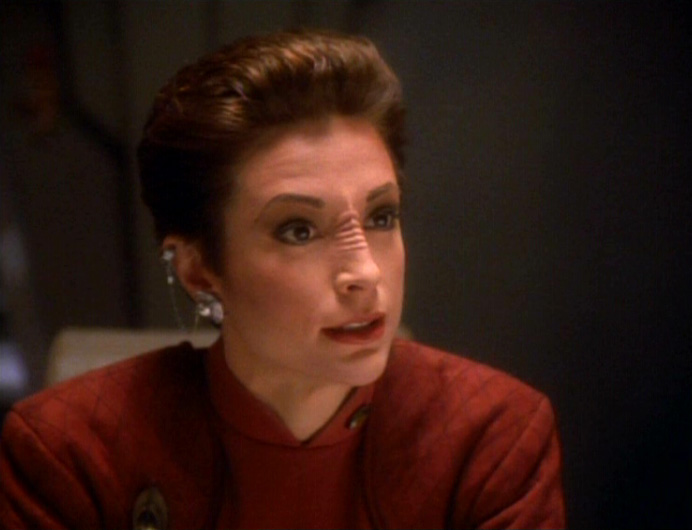
Throughout her interactions with Marritza, Kira is forced to confront many aspects of her own damage and experiences as a freedom fighter that she still has not come to terms with. She is haunted by the things she witnessed during the occupation. She’s still full of rage and a desire for vengeance, even though she understands that vengeance won’t bring about justice or right the wrongs committed by the Cardassians. Her hatred makes it hard for her to see anything past the surface of whatever is going on with Marritza. She desperately wants him to be guilty of everything he claims to have done, so she can have the satisfaction of punishing him. She hopes that this punishment will ease the rage she, and so many Bajorans, still live with every day, even though she also knows that it won’t.
Nana Visitor gives a spectacular and layered performance as Kira in this episode
Fiercely independent, Kira has a tendency to push against everyone around her, especially when she’s sure she is right, which is pretty much all the time! But this episode also makes it clear how much the relationships she has built with others on the station have changed her. The fact that Sisko, Jadzia, and Odo have all earned her respect means she can take a step back, despite her certainty about this particular Cardassian, and look at the things that don’t add up in his story. She trusts her friends and allies enough that she is able to hear them when they tell her that vengeance, in this case, simply will not be enough. Her connections to these people allow her to see past her prejudice and hurt to see the truth.
Underneath all of the obfuscation and lies, Marritza is every bit as damaged by his experiences as Kira. Seeing the horrors committed by his notorious boss, Gul Darhe’el, and being powerless to do anything to stop them, has taken an enormous toll on this outstanding file clerk. Despite the years that have passed since his time at Gallitep, he is consumed by guilt and by a desire to force his people to confront their crimes. He wants to die for what his people did, but he wants his death to make a difference for his people.
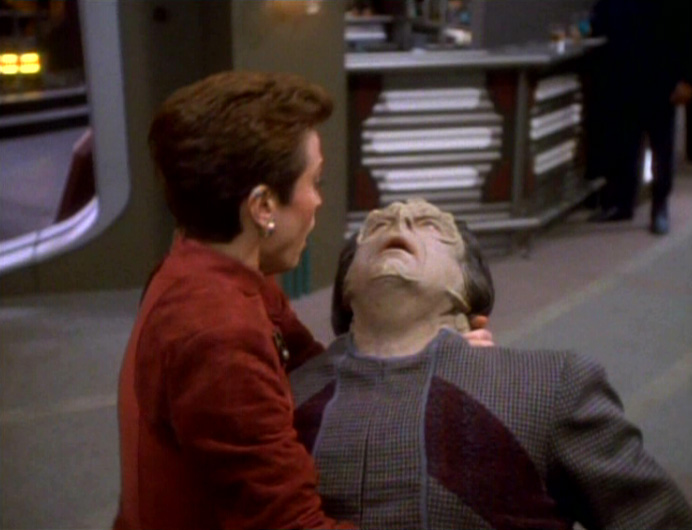
Nana Visitor gives a spectacular and layered performance as Kira in this episode, but it wouldn’t have nearly as much impact if she didn’t have a similarly powerful “opponent” in this particular duet. Harris Yulin plays Marritza so wonderfully that every moment he and Kira spend on screen together is truly “don’t blink” viewing. There is so much tension in every look that passes between them. Cardassians, at least most we meet on DS9, tend to be very voluble speakers all too fond of the sound of their own voice. Marritza embraces that role here with ranting speeches filled with clever wordplay, and a gleeful embrace of every crime he wants to claim credit for. He seems to take great joy in tormenting her with his crimes, but there is always a hint of the guilt and despair he feels just beneath the surface. Kira hates his “smirking, superior, Cardassian face” so much because he is giving her exactly what she expects to see. When he is finally pushed into a corner and forced to admit his lies, his shame and despair are truly powerful and moving. He hates himself, he hates what his people have become, and he simply can’t live with it anymore. He is a version of what Kira could have become and you can see the heartbreak on her face when she realizes how alike they really are. She needs him to forgive himself, because she needs to be allowed to forgive herself.
In the end, Kira realizes just how much she has changed, and maybe even healed. Where other Bajorans feel like “being Cardassian” is reason enough to lash out and kill, Kira knows better. She isn’t the “terrorist” who thinks that way anymore. She sees a different way forward now, much more like the Federation’s path, and now has the burden of sharing that path with the rest of her people.
Continue to Rhonda’s Take: “Visitor and guest star Yulin imbue performances with powerful emotion”
Skip to Ray’s Take: “Intricate and Intriguing Interplay with Layers of Misdirection and Mistrust”
Skip to Matt’s Take: “A Thematic Masterpiece and Tour De Force for Nana Visitor”
Return to Episode Logs or Episode 18 Guide
 Ponderings from the Promenade: A Journey through Star Trek Deep Space Nine
You must be logged in to post a comment.