Rhonda’s Take Episode 1: “Emissary”
This episode is more brilliant than I remembered, so much of the future (and the end) of the series is foreshadowed in this first episode. Despite not being remastered for high-definition broadcast and relying on 1990s special effects, the quality of the cinematography holds up. There’s the occasional blurry moment that reminds the viewer that it is missing the crispness of modern equipment, but it never detracts from enjoyment of the action. I am most impressed by the confidence the writers had that they were developing a continuing series to introduce so many elements that will play out in the long game.
I am not fond of an opening scroll, but it delivers quick context for the battle we are dumped into. An unseen consequence of Picard’s conversion into the Borg “Locutus” unfolds on screen. Our soon-to-be lead Benjamin Sisko, played by Avery Brooks, is aboard the U.S.S. Saratoga at Wolf 359, which is attempting to defend against the Borg Cube led by Locutus. As crew members, including the captain, begin to perish around him, Sisko orders an evacuation. He runs toward his own quarters only to discover the hull breached and debris burying his son and wife. He extricates Jake easily, but his wife, Jennifer, is under a girder he cannot lift. Brooks’ packs depth into his cry to a crewmate, “Help me!” The crewmate must drag Sisko away and we sense that a part of him stays with her. Brooks shows the subtlety of his acting yet again as he glares at Locutus on a view screen, yet he has Sisko maintain composure to reassure his son, “Jake, you’re okay” (a verbal irony that perhaps he is not okay).
The next scene is a contrast to the first. An onscreen card tells us three years have passed as we see Jake and Sisko fishing from a covered bridge on the holodeck. Reminiscent of Andy Griffith and young Ron Howard as Opie, the father and son depart the holodeck: Jake is barefoot and still carrying his fishing pole. They stop at a viewport for their, and our, first glimpse at the station as the theme music swells.

From a storytelling perspective, the writers and director found ways to tuck exposition into every moment. Miles O’Brien, one of two connections to the then airing Next Generation, greets Sisko. Together they tour the station as O’Brien drops important details about the Cardassians’ destruction of the station as they were forced to surrender it to Bajor. The suspicious glances from residents and shop owners as they cross the Promenade tells us, immediately, this is not like previous Trek: gone is the pleasant camaraderie amongst the residents. If we have any doubt, Kira’s first appearance on screen is her yelling at someone and then turning to Sisko to continue shouting, “I suppose you want the office!” She continues to tell him that she has fought for Bajor to expel one oppressor and does not welcome the Federation as a new oppressor. Later in the episode, Sisko comes across Kira clearing debris. She says, “I suppose Starfleet officers aren’t used to getting their hands dirty!” He doesn’t say anything, but begins picking up debris. She keeps talking, which allows us to learn about the source of her anger as she describes life in the refugee camps and her belief, like others before him, Starfleet will abandon Bajor.
When Sisko must report to Picard, who he has not confronted about the events of Wolf 359, we are again faced with tension in the ranks. The thread of discord runs beneath their conversation about the future of Deep Space Nine, but they must remain professional so they do not address Sisko’s anger. In fact, it’s notable that Picard pours himself tea from a carafe while they talk, but does not offer any to Sisko nor does Sisko help himself. The body language between them, particularly the moment when Sisko rises to leave and, with squared shoulders, flicks the bottom of his uniform top is a master class in precise acting. Some naysayers felt that this built-in conflict amongst the crew made it “not Trek,” but conflict is where stories blossom and Deep Space Nine used the conflict to grow its characters and story.
We continue to meet the characters who populate the station and our series. On first viewing, one will know that Odo, who turns to “goo” to let a thrown item pass through him is alien and that his demand of Sisko, “Who are you?…I don’t allow weapons on the Promenade!” establishes him as an important character. Quark, who calmly asks for Nog’s release for his “small part” in the theft only to be rebuked by Sisko, is also hinted at as being important and a possible troublemaker. Nog’s introduction as a thief sets up Sisko’s reluctance to later allow his son to befriend him, but his words to Quark about being a father himself also keeps open the door for his forgiveness. In these same scenes, Quark refers to Nog as his brother’s boy, but, while a keen, informed viewer will see Rom in the background, he is not identified (Max Grodenchik is billed as “Ferengi Pit Boss” in this episode). We don’t understand Quark’s importance until Sisko negotiates Nog’s release contingent on Quark staying on the station and reopening his bar. Odo’s comment that Quark is perfect to represent the community is tinged with their conflict and some subtle satire: “You have all the character references of a politician.” We meet Bashir and Dax as they disembark from a shuttle craft. Our first reactions to Bashir are based on his awkward request to meet Dax for dinner later and then an even more awkward conversation with Kira about his request to be stationed on Deep Space Nine so that he can practice “frontier medicine.” After a measured correction, Kira ends by reminding him that the “frontier” is her home. Sisko comments to Dax that Bashir is too young for her. She says they are only a year apart, but Sisko corrects that they are 300 years apart because of the symbiote she carries. When Sisko calls her, “Old Man,” for the first time, I got chills of nostalgia. As I write about Kira’s reactions to the other characters, I must note that she spends much of the episode angry, but I would not call her an “angry woman,” nor do I think the writers did her a disservice. Throughout the episode, we also see her proficiency at running the station and her cleverness at dealing with the Cardassians, both diplomatically and tactically. I’m not sure how she learned the lingo, but she knows the difference between a yellow and red alert and when to call for “Shields up!” After having O’Brien fire the last of their torpedoes at the Cardassians, she manages to bluff that the Federation may not want a war, but she “is just a Bajoran…if you want a war, I’ll give you a war!” When the Cardassians test her resolve, Nana Visitor has a controlled moment where she turns from the action believing that Kira must admit defeat and then a moment of relief when she turns to see the wormhole open and she knows hope has returned.
This episode also establishes the themes that will be developed throughout the seven seasons to come: the frailty of existence, how we deal with loss, the place religion plays in the lives of believers and non-believers, familial bonds, and the question of where authority should begin and end. The most clear development of all these themes comes during the scenes when Sisko is explaining corporeal existence to the non-corporeal beings who live within the wormhole. Sisko is bombarded with images from throughout his life (conveniently, from a production standpoint, mostly scenes that were filmed for this episode). The beings argue that he exists in all these moments in the current moment, and he must explain to them the passage of time, how humans leave behind the past to move into the future. He explains the purpose of linear existence to help humans learn as he uses the metaphor of a baseball game to explain that the uncertainty of existence—of not knowing the outcome—makes the game, and life, worth living. Throughout the experience, he is returned to moments with Jennifer—their first meeting, an early lunch date, then one where they discuss “domestic” matters prompted by the laughter of children. Time and again, he returns to the moment of her death, and the beings ask if he is meant to move on, why does he exist in this moment. He is forced to admit that he was ready to die with her and, therefore, he never left that moment. Again, we see Brooks’ ability to pack emotion into a single, pained line, “I exist here.” They confirm, “None of your past experiences have prepared you for this?…So, you choose to exist here.” The latter phrase is both a question and a statement. Sisko’s face conveys the realization, which brings him back to himself. We don’t see his final negotiations with the beings, but we know he is able to convey to them the truth of his earlier comments that they are explorers, not there to conquer, but “to coexist and to learn.”
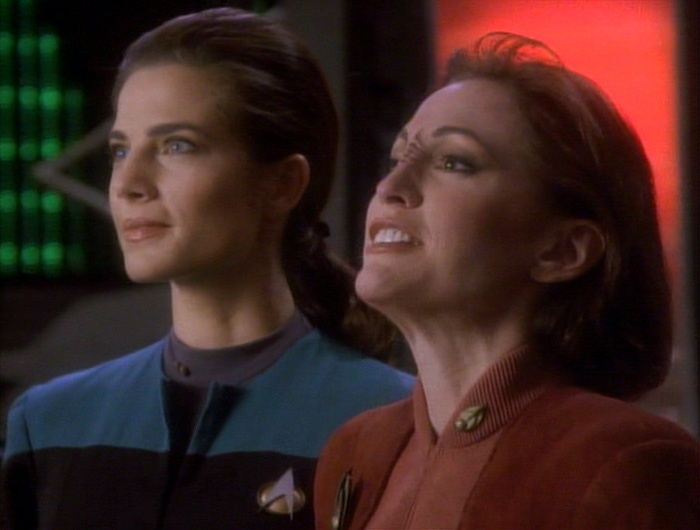
Another complaint about Deep Space Nine was that it was “too dark” to be Trek. I would argue that there is a lot of hope conveyed in this first episode as well. There are numerous scenes where Dax and Kira are framed side-by-side and their teamwork is what finds the wormhole to begin with as well as rescuing Sisko and keeping the station together. Despite bombardment by the Cardassians, there are only injuries, no fatalities. The joy as Sisko and Jake find each other on the Promenade and hug is real. Picard praises Sisko for putting Bajor “on the map,” and then Sisko rescinds his request to be replaced. Picard has a moment of doubt in leaving an officer reluctantly in charge. In Brooks’ slight intake of breath as he says, “I’m certain, sir,” we feel the weight of what he has left behind to move forward in this moment. He has not forgiven Picard, but the men can shake hands and he can accept Picard’s “Good luck!”
In the final moments of the episode we see the characters in pairings that will continue throughout the season and throughout the series: Bashir and Odo; Quark flirting with Kira and her rebuke; Dax, Sisko, and O’Brien discussing the next repairs to be made. These pairings will be fluid. We have yet to meet Garak, who is inextricably linked to Bashir; Bashir and O’Brien have only one meaningful exchange and that is when O’Brien gives the upstart Bashir a history lesson. Other elements are well-established: Odo’s mysterious background, Sisko as emissary, the uneasy balance of Bajor’s importance and Starfleet’s presence, and Gul Dukkat’s ability to be suave and charismatic while being threatening at the same time. I know later in the series Dax and Kira will discuss romantic relationships, but never in a traditionally feminine way. The introduction of their friendship in this episode passes the famed Bechdel test: two women in a scene without discussing a man.
The episode closes with the camera panning across the Promenade and raising for an overhead image that captures this setting that will become the soul of Deep Space Nine and the name of our blog!
Return to Episode 1 Guide
Return to Jim’s Take
Continue to Ray’s Take
 Ponderings from the Promenade: A Journey through Star Trek Deep Space Nine
You must be logged in to post a comment.