Rhonda’s Take on Episode 12: “Battle Lines”

Over the course of four previous DS9 episodes, Paul Lynch has delighted with “A Man Alone” and “Q-Less” and delivered the less stellar fare of “Babel” and “The Passenger,” but with “Battle Lines” he delivers a Master Class on filmography by using all the methods at his disposal to take a strong script by Richard Danus and Evan Carlos Somers to screen. The final product develops a lasting message that will reverberate with the viewer and ripple throughout the episodes and seasons to follow.
While “Battle Lines” stands the test of time and showcases the talent of the production crew, this episode more than any other so far really made me wish DS9 would receive the HD upgrade treatment. The “close talking” amongst characters, which I assume was the fault of filming for a square television screen, rather than widescreen, would not be “fixed,” but some of the effects and muddied backgrounds could be made much crisper. Even without replacing the wormhole effects, having the sharper blues and brighter whites as our runabout passes through would further amaze the audience as it does Kai Opaka. Camille Saviola as Kai Opaka does some impressive silent reacting as the shuttle crashes. Despite being an out-of-focus smudge behind Sisko’s shoulder she conveys the kai’s calm acceptance of whatever moment she is in. This made me wish I could clearly see her expressions.
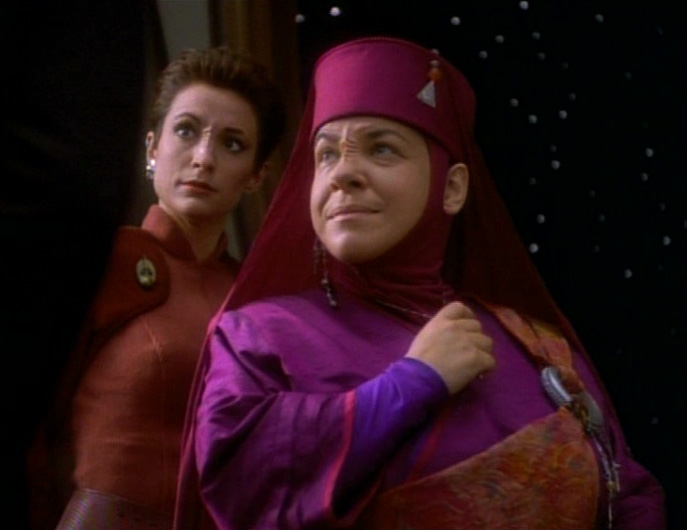
This episode further develops the themes of faith and of war that will dominate much of later episodes and seasons. We see how faith provides strength differently to Kai Opaka than Kira Nerys. We see how war has wounded Kira and left scars on Bajor. The Kai spent her life on Bajor representing the religious sect in relative safety. Kira spent her life in Cardassian work camps and leading rebellions that were often bloody. Kira takes pride in her ability to fight, which is intertwined with her changing identity, as seen several times in this episode:
- In the opening scene, Dax and O’Brien are recapping to Sisko what they found in some Cardassian files that had not been purged. When Kira overhears them mention her, Sisko provides her the memory stick, but warns her that she “may find it disappointing.” She declares she is a “big girl,” but moments later she emerges with metaphorical steam coming out her ears and a stream of angry words dismissing the Cardassians labeling her a “minor operative.”
- When the group of Ennis are attacked and she saves them by shooting so that the ceiling collapses on the enemies, she berates their failed battle strategy and begins marshalling the Ennis troops. Shel-la (Jonathan Banks) tells her that they used to be better, but the inability to actually die has made them lax. At the end of the episode, Kira will tell him that fear of death will not stop a war because it has not stopped any other wars.
- After Kira expresses suspicion that the Nol-Ennis’s willingness to meet to discuss a truce is really a trap, Kai Opaka asks if she sees herself in the Ennis and warns that she cannot absolve herself by helping them. Kira defends herself by separating her war from theirs: “They fight to die. I’ve always fought to stay alive…it was brutal and ugly, but that’s over now. That’s not who I am…I don’t want you to think I am this violent person without a soul.” Opaka holds Kira’s ear to touch her Pah, which sends Kira into tears: “Only when you embrace [who you are] can you move beyond it…In the eyes of the Prophets, we are all children. Bajor has much to learn from peace.” Kira mourns that the Prophets will not forgive her, but Opaka only says that she must forgive herself.
This conversation between Kira and Kai Opaka is, of course, foreshadowing Opaka’s decision to stay on the planet and to help the Ennis and Nol-Ennis find their peace. She announces this decision before Bashir can tell her that she cannot leave anyway. In that moment, I wondered why Opaka would not feel led to return to Bajor to help her people “learn from peace.” Why would the Prophets call her to help these strangers instead? Yet, she expresses belief that her path was always leading to this moment. It is a depth of faith few of us embody.

Scenes with Dax and O’Brien are sprinkled throughout the episode, but their dialogue is primarily technobabble and more a function of plot, which probably could be excised from the episode without much loss. We don’t really need to know that they are looking for certain heuristics to find the lost runabout. They could simply show up to save the day. However, the cranky impatience Colm Meaney imbues O’Brien with is worth seeing. Also, we see his ability to see solutions when he names the “differential magnetometer” that he will need to invent, and does. We also see O’Brien’s quickness to give up the moment before Dax says they’ve found exactly what they were looking for.
Bashir functions in his medical capacity throughout, but the character also provides some levity. He horns his way onto the runabout because it is a “slow day” at the clinic. He is inappropriately enthusiastic about the discovery that the inhabitants on the moon are continually resurrected. He is appropriately conflicted about whether he should reprogram the biomechanical device to no longer resurrect them. He gets a moment of glory when he tackles Sisko to save him from an enemy weapon. He gets a proper dressing down from Sisko, who tells the young upstart, “I don’t need you to interpret the Prime Directive for me!”
Kai Opaka expresses belief that her path was always leading to this moment. It is a depth of faith few of us embody.
Avery Brooks yet again shows both Sisko’s strength and diplomacy. Starting from the moment he gifts Kai Opaka a trip through the wormhole, he shows the deep bond they’ve already formed. When he commands Kira to return to the space station, rather than investigate a strange signal, he quickly belays the order at Opaka’s insistence. However, he holds Opaka’s gaze for a long moment as if searching for the rightness of his decision. He offers the Ennis and Nol resettlement if they can agree to a ceasefire until their rescue because, as he tells Bashir, they have been punished long enough. His arguments to them are cogent. When he sees that the leaders cannot set aside their ingrained hatred for the other, he pivots to address the others to “make [their] leaders stop.” Of course, it is in vain. Yet, he still considers allowing Bashir to reprogram the devices to let the inhabitants die naturally to end this prolonged war and suffering. The Ennis leader botches that by saying that the cure could be weaponized to wipe out the Nol. Without compunction, Sisko leaves the planet without them and leaves them to their own devices. As he locks eyes with Kai Opaka, who tells him their Pah will cross again, we see Sisko’s mixed feelings of being impressed by her choice and also frustrated for her and the work that lies ahead in breaking these groups from long-embedded prejudice.
“Battle Lines” is definitely amongst the top episodes of Deep Space Nine with all elements coming together, including the writing, directing, filmography, to develop the strong themes of faith and the damages of war.
Return to Jim’s Take: “The pointlessness of war writ planet-sized”
Continue to Ray’s Take: “Planet of the living Kai”
Skip to Matt’s Take: “Bad Ideas will lead to Bad Times for Bajor”
Skip to Adam’s Take: “A ‘godless future’?”
Return to Episode Logs or Episode 12 Guide
 Ponderings from the Promenade: A Journey through Star Trek Deep Space Nine
You must be logged in to post a comment.