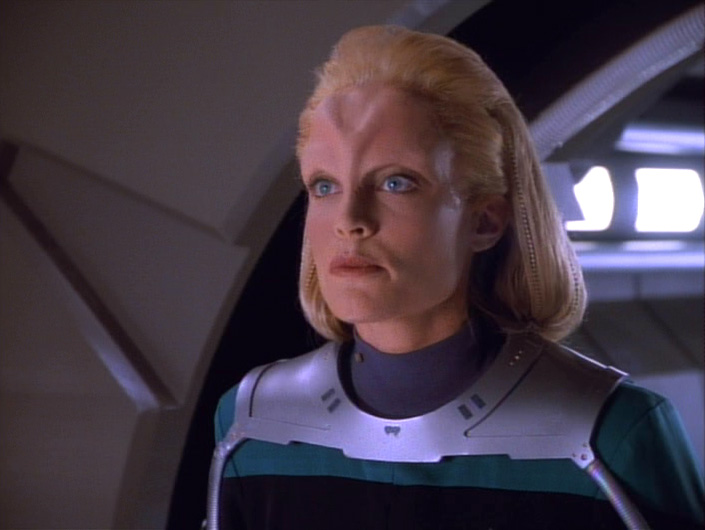
Jim’s Take on Episode 2.6: “Melora”

One of the founding principles of Star Trek has always been the idea that we will reach a future where everyone is equal, all people are valued, all people have a voice, differences are embraced, everyone is allowed to be seen and heard, no one judges anyone because of who they are or how they’re different. Infinite Diversity in Infinite Combinations. All of the Star Trek series have attempted to provide representation of this philosophy through the characters we see on the screen. Because the shows are made in our flawed real world, there have been varying levels of success at truly providing the utopian diversity they seek to espouse, but at least they always try. With “Melora,” DS9 makes a laudable effort to address ableism. I think they handle the subject well, but I acknowledge that I may not be best placed to decide if they have avoided all the possible pitfalls.
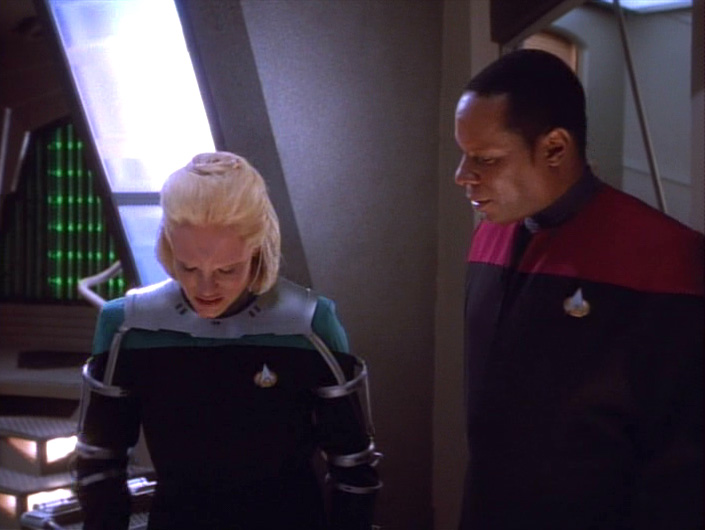
Ensign Melora Pazlar, an Elaysian from a world with very low gravity, arrives on the station with a mission to map some of what is on the other side of the wormhole. As the station’s Chief Medical Officer, Doctor Bashir has been tasked with preparing the accommodations needed for Melora to successfully do her job there. In the process, he has become fascinated, and just a bit smitten, with her before they even meet.
Melora, however, is not prepared to be his fascinating science experiment. Being the first Elaysian in Starfleet, she has become used to being seen as “the Melora problem” and treated as if there is something wrong with her. While it is a little disappointing that Starfleet still has a few such retrograde ideas, it also seems like Melora has reacted a little too strongly by pushing everyone away in her desire to show that she can do her job without anyone’s help. She is quite rightly annoyed at being treated as “lesser,” but another underlying philosophy of Starfleet is the idea of cooperation and working together to achieve what we can’t do by ourselves. Being a “lone wolf” is as wrong for Starfleet as it is to see Melora as “othered.”
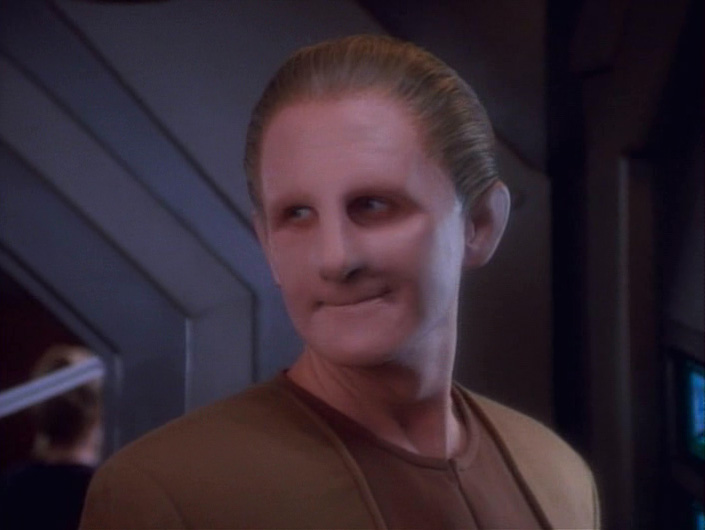
Meanwhile, Quark runs into an old associate, who seems to have a door handle on his face, who spent the last eight years in a labor camp because Quark let him take the fall for the last “business transaction” they were involved in together. Door Handle Face (Seriously, how does a species evolve such an inconvenient feature? I am fully aware that I’m not respecting Infinite Diversity here, but it’s a pretty goofy make-up.) tells Quark outright that he’s here to kill him. After failing to bribe him with food and Dabo girls, Quark runs to Odo for help. Odo’s smile when he briefly contemplates letting Quark get murdered is a wonderful little Odo moment.
Julian is a genius doctor, but he often falls short in knowing how best to interact with others. He does understand what motivates Melora
Julian is a genius doctor, but he often falls short in knowing how best to interact with others. He does understand what motivates Melora’s abrasive attempts to push people away, which leads to their brief, but sweet, romance. They have a lovely date where we all learn that Klingon food looks…bad. However, carried away by his puppy love, Julian mistakenly assumes that the best thing for Melora is to “fix” her so that she can operate in their gravity without any aids or accomodations. At first, she is taken with the idea, but quickly realizes that Julian’s “cure” will fundamentally change who she is. The always-wise Jadzia realizes that Melora is the Little Mermaid in this scenario and that that isn’t going to end well. (They clearly don’t watch the Disney version in the Federation’s future!)
Before Melora can break it to Julian that she doesn’t want to continue his well-intentioned but ill-advised treatments, the A and B plots collide. Handle Face hijacks their runabout to kidnap Quark, completely disregarding Rule of Acquisition #16, by the way: A Deal is a Deal! Handle Face has clearly underestimated these Starfleet types. Action ensues, Melora saves the day, and Julian learns he shouldn’t try to “fix” people to make them “normal.” I love that DS9 makes time for these more laid-back, character building episodes and continues to do their best to provide representation for all and give viewers some important ideas to ponder.

