Rhonda’s Take on 3.13 “Life Support”
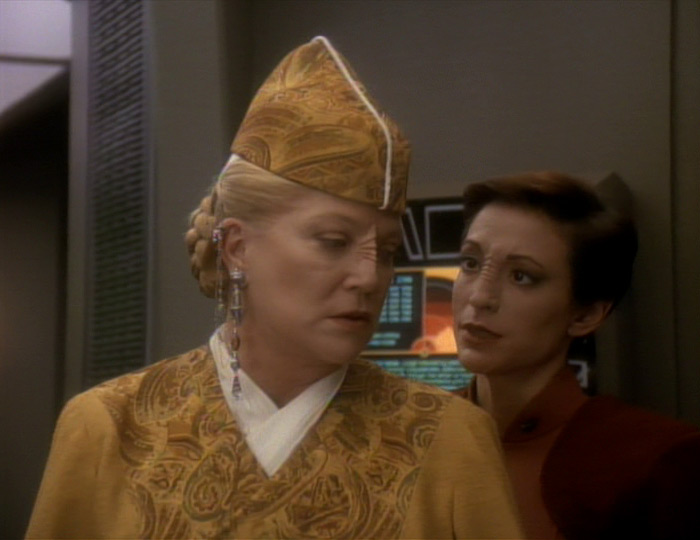
For thirty years, I’ve blamed Kai Winn for the death of Vedek Bareil. She is, of course, the driving force in his poor medical decisions that lead to his death, but she doesn’t seem to be at fault in the shuttle explosion that sends him to death’s door. She immediately asks if it could be sabotage, which is often her method of deferral, but O’Brien says there isn’t evidence of it, and very quickly it becomes
clear that not only could she have been hurt in the accident (something she wouldn’t risk), but she needs Bareil for the negotiations that will occur. Still, I’m not ready to absolve her of his death.
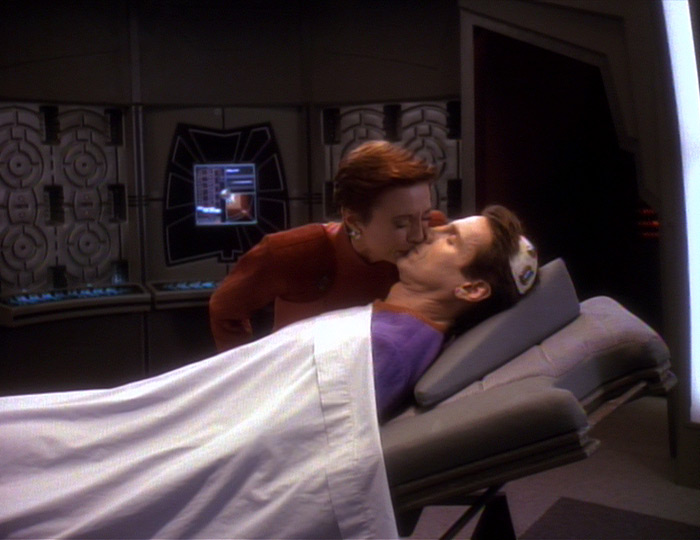
I also should be a member of The Friends of Vedek Bareil, but I didn’t know it existed. I have to assume, like me, they loved Bareil, as portrayed by Philip Anglum, as much as I did, and I know we are in a minority. Many watchers of DS9 questioned the relationship between Bareil and Major Kira Nerys. They doubted this strong-willed woman would be interested in the sedate monk. However, I always thought Bareil was exactly what Kira needed–a steady emotional support to calm her fiery sensibilities. (Maybe I’m a bit too much like Kira and I view my husband as my calm in the storm, so I can relate.) I’m jumping to the end of the episode, but Kira’s final monologue to Bariel encapsulates my thoughts:
“You had… such a… serenity about you… I thought you had all the answers. It really got on my nerves for a while! Then I got to know you and I… realized you were just as confused as the rest of us. You just accepted your confusion better than anyone I’ve ever known. That’s when I realized I loved you.”
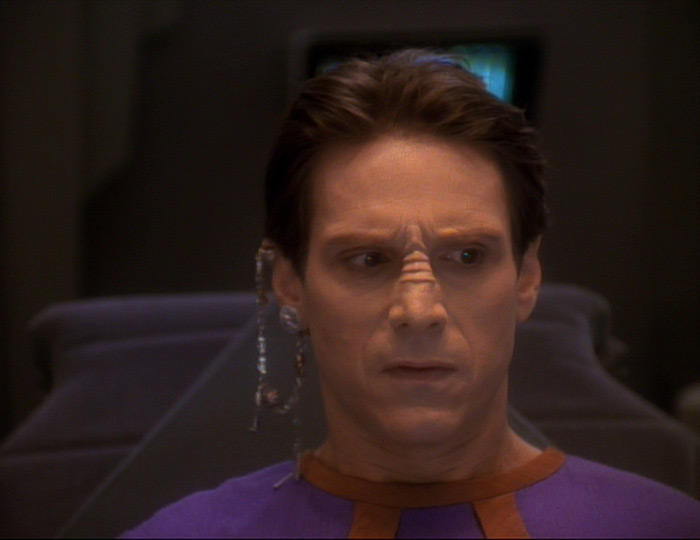
Apparently the writers were on board with the majority of viewers, they “weren’t particularly happy with the way the Bareil/Kira relationship was working out and weren’t certain where it should go” (Erdmann, Companion, 204). I would agree with the Delta Flyers assessment that the scenes in this episode are the best on-screen chemistry between Nana Visitor and Anglum. Bareil’s fight to live long enough to complete the negotiations and his death throes also provided Anglum more emotional heft than usual. The strength of the acting added to my devastation the first time I experienced this loss alongside Kira.

Bareil and Winn arrive on the station after their shuttle has to emergency dock. They were on their way to peace talks with Legate Turrel. This lends credence to Winn’s question about sabotage as there would be parties who might want to thwart such a meeting. The shuttle is filled with smoke, but other passengers seem to disembark with little damage. Bareil must be carried out. His chest is a shredded and burned mess. While Doctor Bashir and his nurse (played by Ann Gillespie) do their best to save him, he doesn’t regain consciousness. When Bashir informs Kira, her face shows clear shock and she says she’ll return to ops. Bashir advises her to take time off, but she says she will grieve in her own way and time. Magically, when Bashir returns to the med bay for the autopsy, they detect electrical charges in his synapses. This is our moment of comparison to Frankenstein, and later, Bashir’s lectures to Kira about Bareil losing his “spark of life.” Bashir, unlike Doctor Frankenstein, however, is a voice of reason, rather than steamrolling for life against all costs, he often discourages Bareil from choosing dangerous life extensions. This extreme sensitivity to Bareil’s wishes and for Bareil’s life are an extension of the new, more mature Bashir who grew into his own during the events of Past Tense.

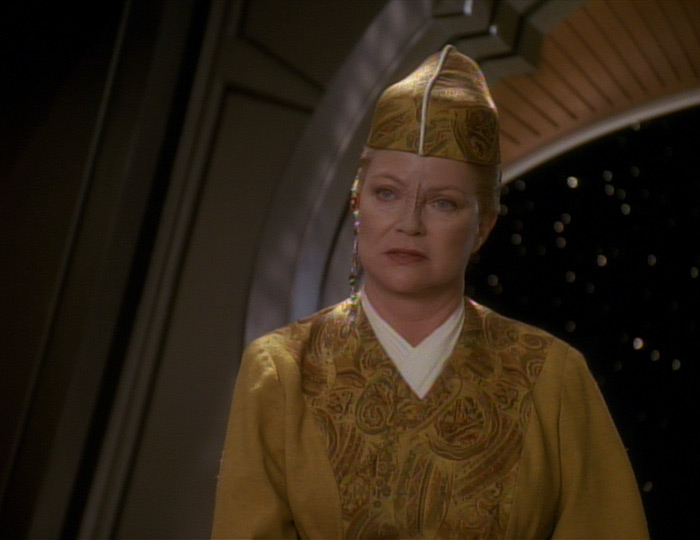
One might argue that Bareil is responsible for his own demise. He does, after all, choose the risky vasokin treatment that will keep him functional for a few days, but might destroy his organs, rather than going into status until Bashir can determine a better, safer treatment. He also chooses organ replacement and refuses to rest. We understand his determination to see the peace talks to their resolution. We also wish Winn would listen to Bashir and that she would release Bareil of this burden, but we know Bashir is correct–as much as she doesn’t want to share the victory, she also needs a scapegoat if the peace talks fail.
As Bareil advises Winn, we see how capable he is negotiating the murky waters of Bajoran-Cardassian relations and how stalwart his decisions are. It gives us insight into the type of leader he could’ve been had he not cowed to Winn’s machinations during the choice of Kai.
Of course, he lives long enough to advise Winn to a successful conclusion, but not long enough to be part of the celebrations. It is a poignant reminder about how meaningless even a hero’s death can be.
Throughout the episode, the title “Life Support,” changes meaning. As I mentioned earlier, I felt the relationship between Bareil and Kira was a type of life support. They each grounded and also pushed each other forward in their healing after Cardassian occupation. Each of the treatments Bareil undergoes are a type of life support. The advice he provides Winn is definitely a life support for her career. Had he died before helping her navigate Turrel’s counterarguments, she would’ve failed. She might’ve even caved to his demands, which might’ve led to the station being returned to Cardassian control. This would’ve ended her political career.
My only quibble with this episode is that someone should’ve argued that the talks be delayed at least by a week. I get Winn’s “we don’t want to lose momentum,” but a week would have done no harm to any momentum. It might not have saved Bareil’s life, but it would’ve given him a chance.
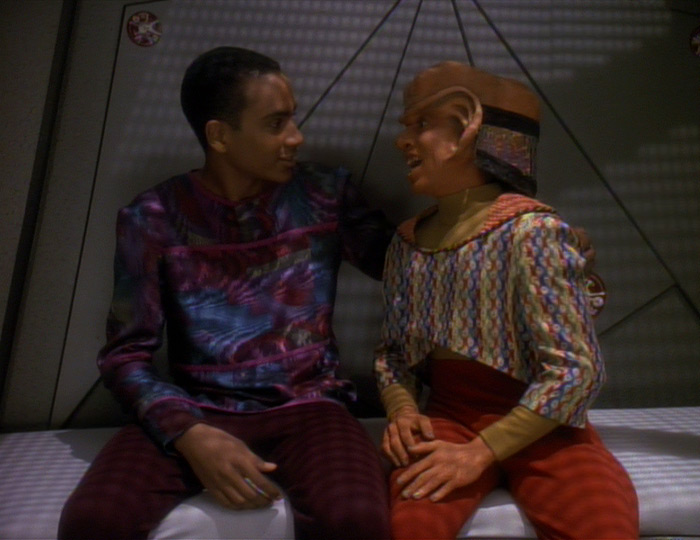
Ira Steven Behr has said that the creators made a huge mistake pitting the serious A story of Bareil’s death against the lightweight B story of Jake and Nog’s double date gone wrong (Erdmann 205). I disagree. I didn’t find the switch between stories jarring at all. Jake and Nog aren’t affected by Bareil’s peril, so they aren’t being callous. Like the humor Shakespeare often inserted after a death scene in his plays, the storyline allows the audience a release of tension. Plus, it’s a wonderful investigation into how two maturing young males from different species can navigate their differences. Both Cirroc Lofton and Aron Eisenberg deserve awards for their portrayal of these characters, especially in this episode.
At the top of the episode, there’s a beautiful panning shot of the promenade as Jake strolls along. He runs into Leanne, who recently broke up with her boyfriend, and who asks Jake if he’d like to meet for dinner. Jake says he has plans with Nog to play dom-jot, but that they can be changed. Little does he know that Nog will assume he’s arranged a double date. This scene contains the fantastic “personal rule” from Nog that “Money is money. But women are better!” He also warns Jake not to embarrass him, which we know will spell disaster the opposite direction, and it does.

During the date, Nog is in full Ferengi mode in his treatment of Riska–he tells her to sit silent and look pretty and asks her to cut his food for him. In this scene, Nog plays toward Jake as if showing off for his male friend, rather than playing toward the women. It is clear who is attempting to impress. When they laugh as if Nog has made a lovely joke, he concludes, “She’s so dumb. She’s perfect.” Riska and Leanne, rightfully, flounce away. Nog and Jake argue about whose fault the failed date is.
After being advised by his father that Nog was simply being a Ferengi and that their friendship has proven that humans and Ferengi can be friends, Jake arranges with Odo for the pair to be arrested. Nog suspects that the arrest doesn’t make sense. Jake admits that he didn’t think Nog would talk to him otherwise. They discuss their differences, including behaviors that make the other “sick,” but they conclude that they can set aside their differences to be friends. While they agree they won’t go on any more double dates, I wondered if Jake will ever encourage Nog to be more respectful to women. While I respect cultural differences, I also think that there are differences that shouldn’t be respected, like those that lack respect for a group of people.
Unlike most A and B storylines in Trek, where they thematically support each other, the two stories here don’t seem to tie together. However, there are links between them about choice–Bareil chooses to sacrifice himself for his people; Jake and Nog choose to nurture their unlikely friendship. Both stories could stand on their own, but together they show the audience a celebration of life from the tears to the laughter.
 Ponderings from the Promenade: A Journey through Star Trek Deep Space Nine