
Rhonda’s take on 3.11 & 12 “Past Tense”: Parts 1 & 2
What more can I add to the conversation about this well-regarded set of episodes from Deep Space Nine? Little that hasn’t already been said, but, if you’re reading this blog, you must care what us Ponderers think, so here goes.
Unlike some two parters where the first episode feels like a simple set-up for the second part, “Past Tense”: Part 1 feels complete, even though it ends on a cliffhanger. Part Two builds from there. Together, the episodes explore the human condition in a meaningful 90 minutes of television.
The first episode begins with our main cast aboard the Defiant preparing to attend a conference on Earth at Starfleet Headquarters. There’s light banter about Commander Sisko, Lieutenant Dax, and Doctor Bashir attending dinner at Admiral “Droner” Drazman’s, which the others happily defer attending.
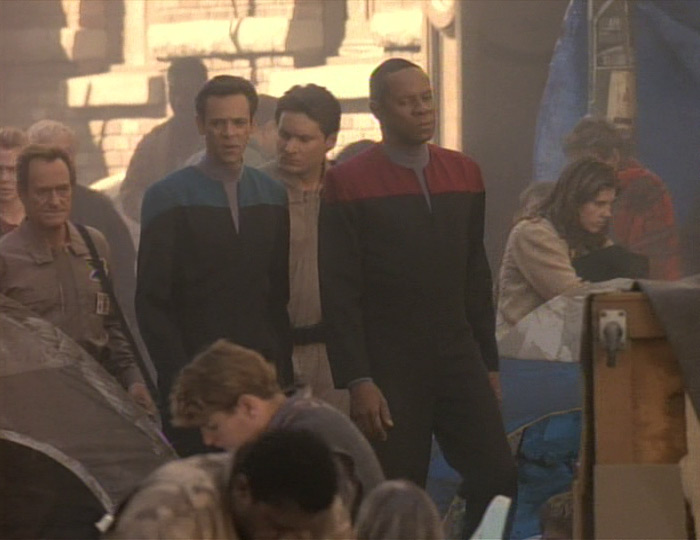
When the three beam down, they don’t arrive in San Francisco as expected. Well, they arrive in the proper location, but not the proper time period. On Earth, Sisko and Bashir are picked up by police and taken to a Sanctuary that seems the opposite of a place of refuge or safety. Meanwhile, Dax is taken in by a handsome, Ted Turner-esque businessman, Chris Brynner, played by Jim Metzler. The point of these two divergent paths cannot be mistaken–the brown men are treated with disdain, the white woman is treated with empathy.

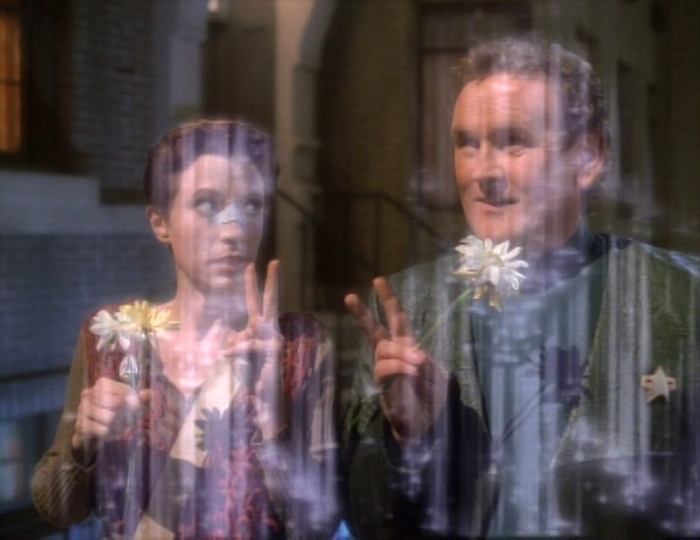
On the ship, O’Brien, Kira, and Odo must suss out what has happened–they competently determine that it was “chroniton” particles that displaced their crew in time. By the second episode, they begin figuring out how to use residual chroniton particles to make several jaunts to different time periods. While the Earthbound adventure is the meat of “Past Tense,” O’Brien and Kira popping into different, very recognizable eras of conflict, such as the pre-war eras of 1920s and 1940s, provides a bit of levity. When they land in the 1960s, they are so stunned by the gift of single daisies from a pair of hippies that they forget to hide before beaming out. Luckily, the hippies are probably high enough to chalk it up to a good trip. The shipboard story also provides the counterpoint showing that Sisko, Bashir, and Dax have changed the timeline when Federation Headquarters and all the communication arrays disappear. O’Brien conjectures that the residual chroniton particles have created a bubble around the ship that is protecting them from the changes.

In the Sanctuary, Sisko and Bashir wait for hours among a crowd of other unfortunates. Bashir notices that many are suffering from mental illness that could be easily treated. While looking at the clock, Sisko realizes it is August 30, 2024, only days before the Bell Riots, a pivotal moment in Federation history. The historical figure, Gabriel Bell, for whom the riots are named is known to have kept a group of hostages alive, which added to the power of the protest for those in the sanctuaries. This simple act forced the world to once again pay attention to those in need, which put them on the path toward post-scarcity. Even if this is the first time you’ve seen this episode, you can immediately feel the sword of Damocles begin to swing above their heads. Therefore, it is no surprise when Gabriel Bell dies trying to save Bashir and Sisko from a fight with Ghosts (the slang term for less desirables in the sanctuary). It’s even less of a surprise when Bashir and Sisko stumble into a hostage situation and Sisko announces his identity as “Gabriel Bell.”
The second part picks up here. This episode is largely a bottle episode with our players confined to the processing center with the asides to the ship and Jadzia. Sisko and Michael Webb try to negotiate with Detective Preston (Deborah Van Valkenburgh) to close down the Sanctuaries and reinstate the Federal Employment Act. She agrees to present their demands to the governor, but returns a short time later with the governor’s counteroffer: he’ll reduce the charges against Bell and Webb. Webb strongly rejects the offer, implying that they won’t see the hostages if the demands aren’t met.

Sisko, as Bell, defends the hostages against the leader of the Ghosts, who took the hostages in the first place. BC, named after an assistant director, could’ve been a hated figure, since he led to Bell’s death, but, as played by Frank Military, he remains sympathetic as the audience understands what led him to his criminal choices and his sense of rage. When he gives Danny Webb his beloved fedora, we know he has accepted he might be dying for those choices.
Meanwhile, Dax sneaks into the Sanctuary via the sewers, finds out they need access to television networks to get the residents’ stories out, and then sneaks back out to convince Brynner to get them on his airwaves. Despite hearing these traumatic stories from everyday people, the governor sends troops in to retake the district. However, it is clear that the bloody carnage of unarmed civilians changes public perception, which restores the timeline.
I have always wondered why the riots became known as the Bell Riots, rather than the Webb riots. There’s the weird sense of paradox around this episode that perhaps Sisko was always Bell and that Dax’s connection to Brynner is how the residents told their story. We don’t know if another history existed before their actions.
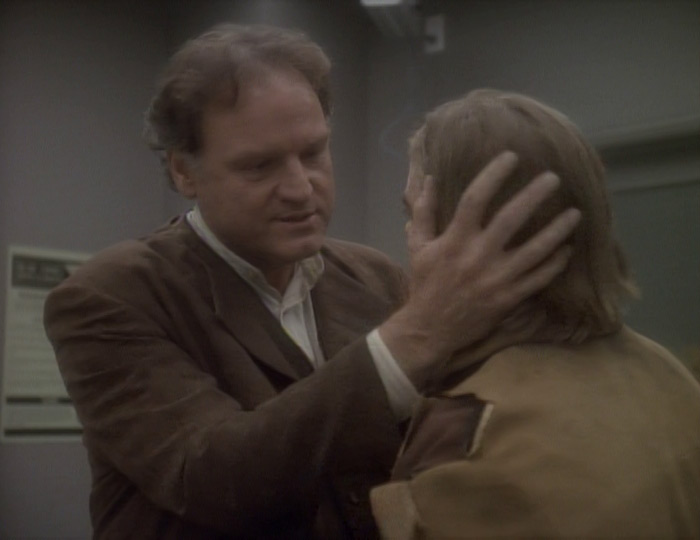
As is, Sisko takes a backseat during the actual hostage negotiations and pushes the white, family man Michael Webb, played by Richard Lee Jackson, into the limelight. Not only was Webb the “face” of the resistance once the hostage situation begins, he’d been working to arrange a peaceful protest prior to BC’s rash takeover.
To me, this seems like Webb was the more important actor during the riots. That being said, if they’d been called the Webb Riots, Sisko might have stayed completely out of the situation. Oh, those paradoxes!
An interesting side fact to the onscreen tale is that when the writers broke the story, an LA Times headline, “Homeless Camp Weighed in LA Industrial Area,” appeared. This plan to move homeless from downtown LA to an out–of-sight area made many question if the writers had known about it. The writers said they didn’t, but it reflects that sense of zeitgeist, what we know is happening in society even before it is known.
We are barely half a year past August 2024 and this episode seems as prescient now as it did in 1995. We haven’t walled Sanctuaries in our cities, but we are suffering a homeless epidemic. Even in my mid-sized city, the number of homeless is higher than previously. We’re also in a political hotbed of distrust of others. The Executive Branch is making plans for mass deportations, which might include reopening Guantanamo Bay, a prison island with notorious roots in housing suspected–and never tried–terrorists after September 11, 2001. Placing immigrants without trial and guilty only of being in the country illegally into such conditions feels remarkably like Bashir’s recognition of the Sanctuaries allowing people not to feel for others. If you’re doubting that we could recreate the 2024 of this episode, I pose the same question Dax asks Chris, if the sanctuaries are meant to protect the residents, “Why is there a wall around it?”
One of the reasons I am an avid Star Trek fan is that, even in such a dark episode, there is always a sense of hope. There is hope that humanity will get better. As Bashir tells Vin, Bernardo, and Lee, “I know that someday there won’t be a need for places like this.”
Episode Highlights

- This is one of the largest exterior shoots, including ninety or so extra. Thankfully, for the makeup team, just dirty, homeless humans, rather than complicated alien makeup effects (Erdmann, Companion, 197).
- Dick Miller’s crotchety police officer Vin, who jumps out to tell the invading government officials they are endangering the hostages, which leads to Sisko AKA Bell being shot to protect him. There’s some implication that him retelling his experience is what gets the riots named after Bell.
- Clint Howard, who played Balok in The Original Series, appears as a mentally ill resident Grady, who steals Dax’s combadge. In the hilarious scene, he tries to be invisible from invading aliens only to return Dax’s “jewelry” because she’s a good alien and needs it to defend Earth.
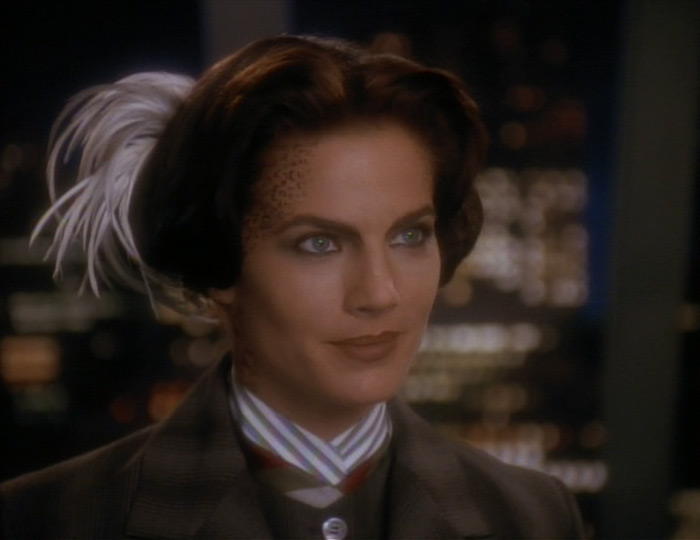
- Terry Farrell wearing the 1990s version of 2024 high fashion with a mini skirt, jacket with shoulder pads, and an up-do with a feather!
- Bashir’s final transformation from childish lothario in the earlier seasons into a fully competent, caring, mature doctor. “Causing people to suffer because you hate them is terrible, but causing people to suffer because you have forgotten how to care? That’s really hard to understand,” he comments to Sisko. He seems to carry this message with him long after this episode ends.
 Ponderings from the Promenade: A Journey through Star Trek Deep Space Nine