

Rhonda’s Take on Episode 2.15: “Paradise”
You know something is going to go wrong in an episode called “Paradise”! As soon as we land on a planet that has eschewed modern technology, we know our modern tech-reliant engineer and commander are in for trouble.
Points of Discussion
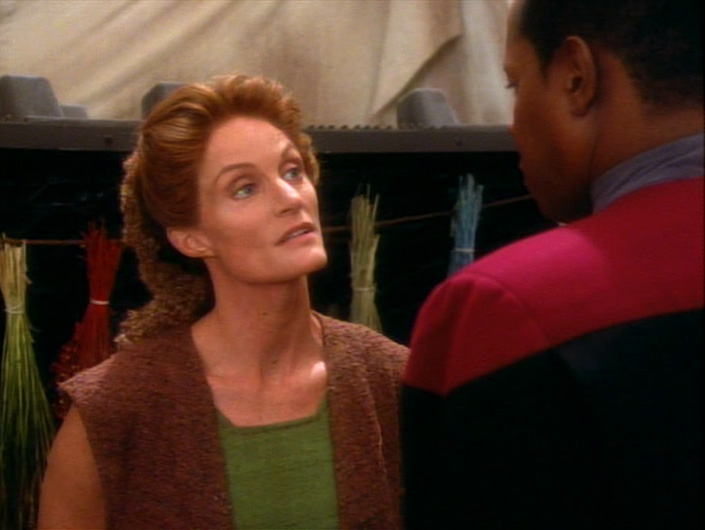
- What is Alixus guilty of? She manipulated the situation the villagers are in by choosing a planet and crashing them onto it. She used technology to prevent them from leaving and to mask their presence on the planet. She didn’t tell anyone about her plan or ask their consent. However, she has led them for a decade, built a stable community, and only lost three inhabitants. She must’ve done something right because, in the end, the others don’t leave and choose to stay. This discussion can be ended with Sisko’s final words to her: “You were willing to let them die for your philosophies.”
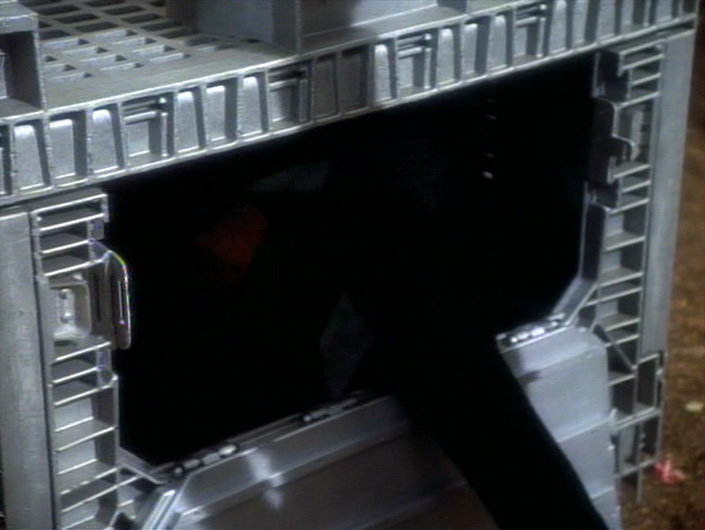
2. Can you put a Black man in a box? Apparently, in 1993, you could. On an episode of The Pod Directive, Tawny Newsome and Paul F. Tompkins engaged in a discussion with TV critic Emily VanDerWerff about the weird slave imagery invoked by Alixus’s punishment of Sisko. They debate (without concluding) whether or not the writers or directors realized this. Having heard many interviews where Avery Brooks espounses his view of racist behavior, it seems unlikely that he wouldn’t have examined the imagery. It softens the racist angle a bit that we first see a white man, the candle-stealing Stephan, being pulled from the box before Sisko is locked inside. It also softens the racist angle that we don’t see Sisko inside the box. We do, however, see his painful crawl back to the box in defiance of the oppressive demands of Alixus. The fact that O’Brien is working in the field during this scene also steps away from a racist angle allowing Alixus’s oppression to stand as its own brand of insanity. In the end, the oppressed prevail and Sisko can tell Kira that “Everything is under control” and mean that he has regained it.

The fact that O’Brien is working in the field during this scene also steps away from a racist angle allowing Alixus’s oppression to stand as its own brand of insanity.
3. Does technology separate man from his true nature? This is the root of Alixus’s argument, yet at every opportunity, Sisko defeats the idea. He shows that technology has improved life, especially when it comes to the medical advances that mean saving lives. However, it is worthwhile to revisit our relationship to technology. When O’Brien complains to Joseph that “nothing works,” Joseph’s rebuttal is succinct, “We do.” Despite being tricked by Alixus, the former engineer appreciates that their luddite community has allowed them to rely on each other more deeply and he decides that he wants to continue this naturalistic lifestyle. Neither he nor our officers poll the others, but no one speaks up to be saved. The message here seems to be that being overzealous in either direction is dangerous.

4. Is sex for manipulation okay if the parties consent? Alixus argues that Cassandra wanted to offer herself to Sisko and that she only encouraged Cassandra to do so. We sense that Sisko recognizes Cassandra as a beautiful woman, but we never sense that he is tempted. If he had allowed Cassandra to massage him and to carry it through the happy ending, would he have been in the wrong? He sees it as an abuse because he does not believe it is what Cassandra wants, rather what she’s been directed to do, so he finds a way to spurn her advances without demeaning her. He does not, however, mince words in confronting Alixus, who he finds “contemptible.”
This whole sequence is O’Brien’s lessons in badassery

5. When should we question authority? O’Brien saves the day…again. Miles seems like a character who falls in line to authority, but he doesn’t when he believes the authority is misguided. Throughout this episode, he defies Alixus to determine what is jamming their technology. He is not deterred by Alixus’s punishment box. When he cannot get Joseph’s help, he finds a way to absolve Joseph from getting into trouble by knocking him unconscious. This whole sequence is O’Brien’s lessons in badassery: He tricks Vinod with the uniform-in-a-tree and then hauls him back in shackles, but not before delivering the great one-liner, “You finally got one of us out of uniform.” He phasers the lock on the box and demands someone bring Sisko water. He verbally tears apart Alixus. Go, go, Miles O’Brien!

6. What’s up with the two kids staring at the box at the end? It’s hard to believe in an episode so full of symbolism (that box; Alixus’s harping on Sisko changing out of his uniform) that this last scene wasn’t designed to tell us something. Yet, all I could think was that these kids were thinking, “Um, could we come with you? We’d really like some video games, instead of this punishment box!” Maybe we’re supposed to feel like the box will no longer be used, but, while Joseph didn’t seem as zealous as Alixus, he had accepted her teachings. It’s a discordant note in an otherwise evocative episode.
This episode feels inconsequential to any narrative beyond itself, yet it offers so much richness to the audience’s experience that it is worth repeated viewings.
 Ponderings from the Promenade: A Journey through Star Trek Deep Space Nine