
Rhondas’s Take on Episode 2.10: “Sanctuary”
We often talk about character development on this website, but “Sanctuary” is very much an episode about place. The Skrreea have been displaced by the Dominion conquering their planet. (Did you catch this second reference to the Dominion? New viewer, are you sensing something is brewing?) Yet, it is not their home planet that gets developed here. Without setting foot on Bajor, the planet becomes very real to us as a planet in turmoil and struggling with identity and survival.
The episode starts with a tetchy scene between Major Kira and Commander Sisko. He is asking again for a duty report that keeps being delayed by her dealings with the provisional government. Dealings that she thought she kept to an angry whisper. Sisko offers sympathy and permission to continue fighting with them, except when it interferes with her duties. This discussion establishes the struggles occurring on Bajor.

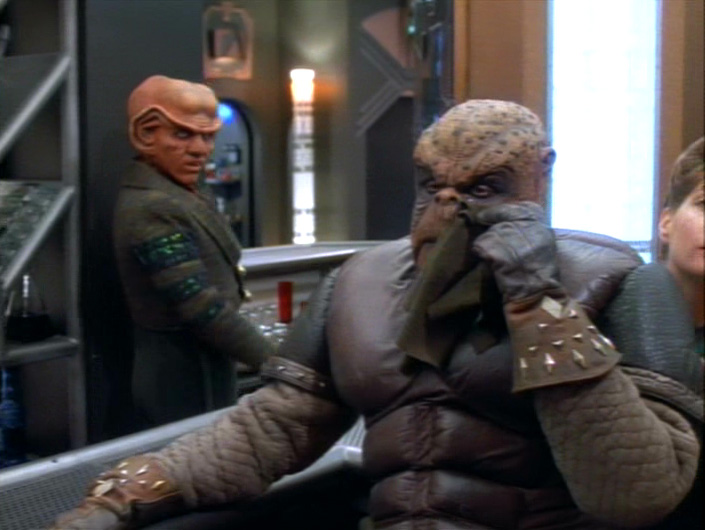
Then, Kira must mediate between Quark and a musician she has forced Quark to hire. The musician was well known on Bajor and she wants to give him a performance venue, but Bajor itself no longer has concert halls and, with the other struggles occurring on the planet, arts are not on the top of the list. It’s a beautiful argument for the humanities as Varani says that the arts should be a higher priority if Bajor is going to reclaim its self-worth. Varani will be the voice of context throughout the episode as he comforts Haneek and advises Kira. “Being Bajoran, I know what it is like to be displaced,” he will tell Haneek. He will tell Kira that their rejection or acceptance of these immigrants will either stunt or further the planet’s healing.
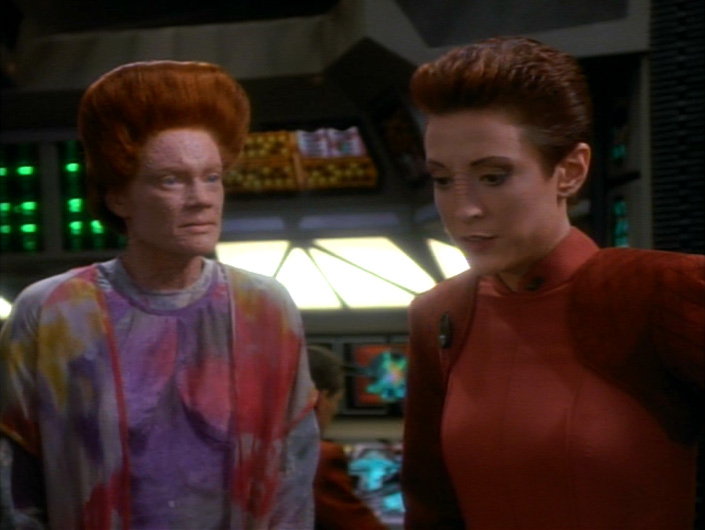
The opening scenes effectively provide context to the decision Bajor will make about the refugees, a small group of whom appear in the final seconds before the opening credits. (The wormhole is apparently a very dangerous place because this is at least the third ship that comes through about to explode and where individuals must be beamed into Ops!) The appearance of Haneek and three men give us a chance to explore several facets of the tech of Trek and gender politics. First, the new arrivals cannot communicate with our crew because the syntax of their dialect prevents the universal translator from immediately providing the translation. It’s a nice story detail, but also provides a bit more reality to the fiction. After all, it stands to reason that language would be very different in the Gamma Quadrant and Alpha Quadrant technology would not be programmed for it. Second, Haneek, who seems to be the leader of the group, focuses on Kira to try to communicate. The men also only follow Kira’s commands. Later, we will find out that the Skrreea society is matriarchal. Haneek’s comments that men are “too emotional” for the responsibility of leadership reflect the attitude our current society holds toward women. Her defense that “we love our men…really” is as ridiculously misandrist as the modern attitude is misogynist! Although there’s a certain tongue-in-cheek glee, when Kira awakens Haneek from her slumber with two of the men who she is bonded with and she says that they are “useful.”

The Vulcan saying “Infinite Diversity in Infinite Combinations” is often trotted out in Trek, but here we see that not all species are so enlightened.
The Vulcan saying “Infinite Diversity in Infinite Combinations” is often trotted out in Trek, but here we see that not all species are so enlightened. The Ferengi are particularly unaccepting of the Skrreea, who “look and touch and don’t buy” and whose skin seems to leave flakes behind (I did keep thinking their skin looked like chunky oatmeal!). Nog’s teasing of them leads to Tumak, one of the original refugees, declaring that they are not wanted on the station and they do not want to be among those on the station.
It’s unfortunate that, what I assume were, budgetary constraints meant that Tumak’s death is a light going out on a screen. We don’t see the firefight between him and the Bajoran ships. We don’t see a cutaway to Tumak and the other boys, who I like to imagine were begging Tumak to turn off the engines and live. The death lacks emotional punch.

The Skrreea’s interpretation of the wormhole as “the eye of the universe” and their belief that it will lead them to their legendary homeworld, Kentanna, “a planet of sorrow where the Skrreas will sow seeds of joy” provides a nice reflection of the Bajorans faith in the wormhole aliens as prophets. The obvious physical and societal differences between the Skrreans and Bajorans seems to nix the idea that Bajor is Kentanna. It is possible whatever sent the Skrreans through the wormhole also took them on a different evolutionary path. It is ironic that Bajor was occupied by the Cardassians and the Skreeans were oppressed by the T-Rogorans. It is undeniable that Bajor is currently a planet of sorrow, and perhaps too obvious that the Skreeans, who are presented as an agricultural society, could plant literal seeds in the plains of the northwest. The Bajorans, however, determine that they cannot absorb the three million Skreean refugees because, even though the Skreeans might not ask for help, Bajorans would deprive their own out of obligation if necessary. It feels like a specious argument, but one that bureaucracies often make (we could spend another essay discussing the parallels here with the United States denying our southern neighbors sanctuary or any number of refugee crises internationally). Haneek’s chastisement to Kira that Bajor has made the wrong decision out of “fear and suspicion” could easily be chastising contemporary governments.
One senses that the plight of the Skrreea will not be forgotten on Bajor, but I don’t remember them being mentioned again on the show. However, it feels like an ongoing discussion of whether they made the right choice.
Is it as Kira argues best for both groups?
Is it as Haneek argues wrong because the Skrreea could’ve helped Bajor?
The symbolic separation of the two as the airlock closes and physically separates them is an excellent exclamation point on this episode.
 Ponderings from the Promenade: A Journey through Star Trek Deep Space Nine