

Rhonda’s Take on Episode 2.8: “Necessary Evil”
I’m all about making lists: To Do, Wish, Future Plans, Pros/Cons, Gift.
Odo would not be surprised by my penchant for making lists, as he has observed that humans have a tendency to create them for everything to a degree that means they have to create new ways to keep them.
So it shouldn’t be a surprise that a list is at the heart of “Necessary Evil.”
Except I don’t understand why a Cardassian collaborator has a list of fellow collaborators hidden in his wall.
It makes perfect sense that his wife uses it to blackmail her fellow collaborators, but why was it written down in the first place? Did Vaatrik have a poor memory that he needed to write down eight names of people who should’ve been fairly obvious to him? For that matter, why did Kira Nerys need to steal it? Again, it seems that collaborators were fairly obvious if they were given privileges such as the Vaatriks’ had: private quarters alone should be a dead (yes, that’s a pun) giveaway. As Odo notes, Kira quickly discovers “Ches’so” so she must’ve had her suspicions all along.
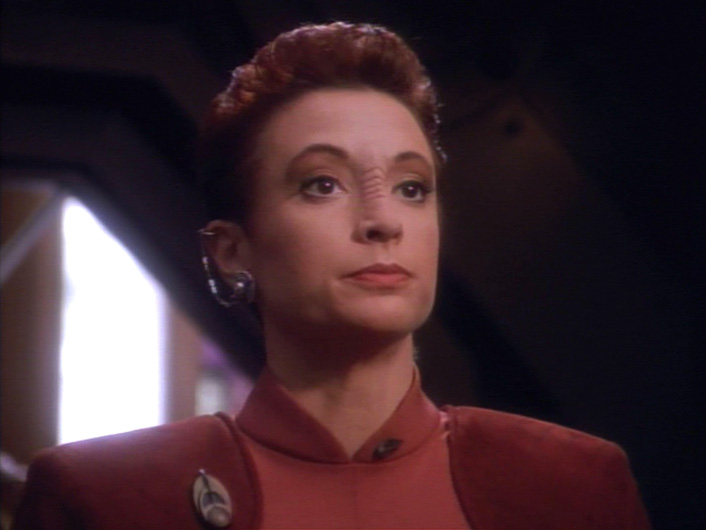
It doesn’t matter why the list exists because it provides a lovely inciting incident to tell a story about Kira and Odo.
This episode also contains a lot of firsts: Odo’s first log, flashbacks to Odo’s first investigation, Odo and Kira’s first meeting, and Gul Dukat’s first appearance as the leader of Terok Nor allowing our first time seeing the deplorable conditions the occupation created. It also mimics the film noir genre with Odo’s log providing the PI’s monlogue, Katherine Moffat playing the femme fatale, Pallra, and the lighting and camera crew using light and shadow to create atmosphere. The camera does so much to create atmosphere throughout. The director uses the camera to carry us between the present and the past, such as a cut between children running around Morn on the brightly lit Promenade in play to children hanging onto a fence looking hungry on a gray, crowded Promenade.
Even though this is an Odo and Kira episode, we learn a lot about Quark, Rom, and even Nog. When Pallra asks Quark the favor, he acquiesces immediately for the reward of her “personal gratitude” (Oh, our little Ladies’ Man!). When Rom assists Quark with breaking into the Chemist’s Shop, we learn that he has quite a skill at picking locks and opening safes. We also learn that Nog has made Rom a “desealer,” which hints at his future in engineering. When Quark is shot, Rom is torn between being upset by the loss of his brother and glee at inheriting the bar.
Avery Brooks was absent most of the last episode and this one, but his presence is always there and Sisko is used for pivotal scenes, like his manipulation of Rom into confessing what he knows. At first, Sisko sounds sincere in asking Odo to let go of his suspicions of Rom, since Rom is a “personal family friend.” It doesn’t last long as he tricks Rom into telling Odo why Quark was shot.
Marc Alaimo continues to delight as the snake-like Dukat. I know the flashbacks are Odo’s memory, but, geez, how does the leader of Terok Nor have so much time to lurk around so he can emerge from the shadows just in time to almost hear important reveals? Unlike his Cardassian counterparts, who see Odo only as a parlor trick, he sees Odo’s potential and uses the moment when a Bajoran has been killed (one who is important to Cardassia, although we don’t know that yet) to capitalize on that potential.
On the surface, this episode seems throwaway. A nice character study, nothing more. But, it deserves a place on our List of Favorite Episodes.
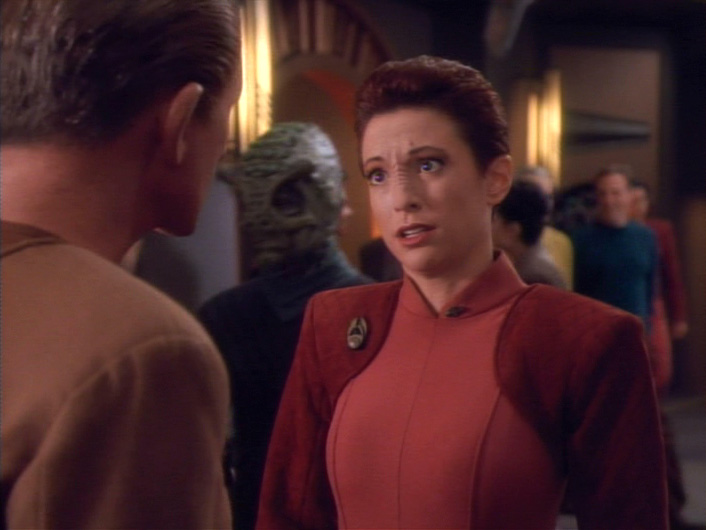
Which brings us back to Odo and Kira. Those of us on a repeat trip through DS9 know we have much to look forward to with this duo and, whether the writers knew it here, the actors certainly played it as a deeply held connection.
As soon as Kira hears that Quark broke into the Chemist’s Shop, she connects it to Vaatrik’s murder. She asks Odo if he wants to discuss it, because they haven’t. He curtly dismisses her offer because he found her innocent then and wants to leave her innocent. We are not surprised when the episode later reveals that Kira was indeed guilty (the “necessary evil” of the title). We are even less surprised by their stoic exchange that bubbles with the undercurrent of emotion.
Kira: “I tried to tell you the truth a hundred times…What you think matters a lot…I was afraid…”
Odo: “…That it would affect our friendship? (pause) Maybe it doesn’t have to.”
Rene Auberjonois conveys so much emotion in his heartbroken, yet compassionate, look at Kira and in his posture and bowed head as the camera goes to a wide shot and the closing notes play.
On the surface, this episode seems throwaway. A nice character study, nothing more. But, it deserves a place on our List of Favorite Episodes.
 Ponderings from the Promenade: A Journey through Star Trek Deep Space Nine