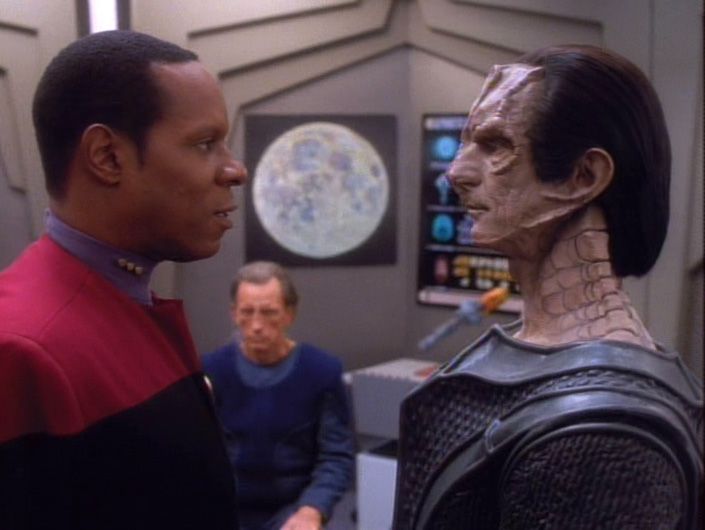
Jim’s Take on Episode 5: “Cardassians”
Cardassians! Those reptilian rapscallions sure do get up to some wacky hijinks. Between the genocide and their immaculate filing, it’s a wonder they even found time to really, properly, abandon all those war orphans. Seriously, though, one of the elements that makes DS9 unique amongst Trek shows is that the stationary *ahem* nature of the space station means they get to do so much more to flesh out characters, political situations, and groups of people. On TNG, the Cardassians just showed up for an episode to be generally evil or a bit of a nuisance and then our heroes went on about their business sorting out Q or the next weird space anomaly. On DS9, the Cardassians are given time to be truly developed and seen as complex, confounding, complicated people. It’s an impressive achievement that makes Cardassian characters fascinating to watch in action.
“Cardassians” is a fantastic episode, but before I heap some much deserved praise on the story itself, let’s address that title. “Cardassians”? Really? That’s the best they could come up with? I mean, there are quite a few Cardassians in it, but still… That is the most generic title possible and no one will ever remember it. One thing the original series did better than pretty much every Trek that has come since is come up with memorable, poetic, intriguing episode names that fans remember over 50 years later: “The City on the Edge of Forever,” “Requiem for Methuselah,” “For the World is Hollow and I Have Touched the Sky,” “Balance of Terror,” “The Doomsday Machine.” Those are some amazing and memorable episode titles! Those are titles that make you want to see the show just to find out what that title is all about. Lazily saying, “Well, this one is about Cardassians, so let’s call it ‘Cardassians’” is just not in the same league. (To be fair, Discovery has definitely tried to up their title game to be more in line with the original series. They may not always succeed, but they try!)
The fact that [Andrew Robinson] makes us, Julian and the audience, love [Garak] even when we have no idea at all if we can actually trust thim, is a truly impressive feat of acting.
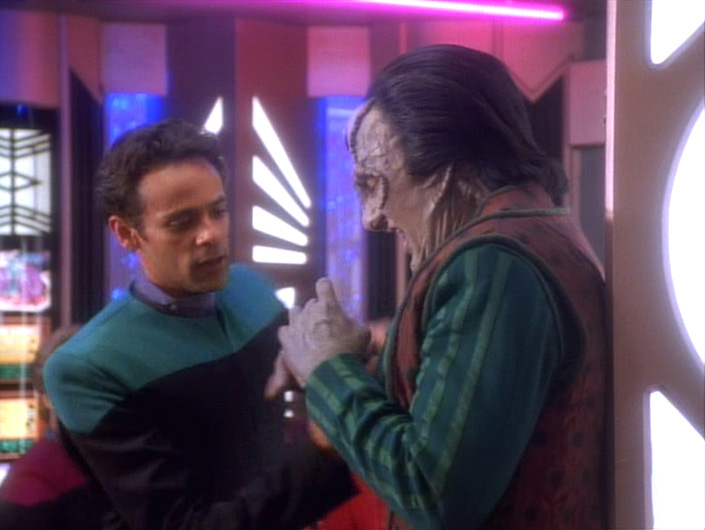
Moving on. The greatest thing about this episode is the return of Garak. Good ol’ plain, simple, Garak. This show needs to have much more Garak content per episode. His wonderfully enigmatic and evasive character is so much fun. He gets all the best lines. Some of this may be down to Andrew Robinson’s performance, but he clearly inspires the writers to create such wonderful, layered, dialogue that hints at so much without ever actually committing to anything. The fact that he makes us, Julian and the audience, love him even when we have no idea at all if we can actually trust thim, is a truly impressive feat of acting. What is he up to? What does he actually want to achieve? Is he a spy? And if so, for whom? We just don’t know and that ambiguity is part of the fun.

This is also a great episode for Julian Bashir. Our young doctor has already come a long way from the callow youth he was when he first arrived on the station.
This is also a great episode for Julian Bashir. Our young doctor has already come a long way from the callow youth he was when he first arrived on the station. He sees through Garak’s facade and is ready to go toe to toe with him when he needs to. He’s not afraid to stand up to Sisko or Gul Dukat, and he takes the lead in the investigation into what’s really up with Rugal’s orphaning and Dukat’s “concern” for the orphans. He even gets a real “Poirot” moment when he reveals all at the hearing to determine what will be done with poor Rugal. The best moments in “Cardassians” are the interactions he has with Sisko when he unexpectedly inserts himself into the proceedings. “Don’t apologize, it’s been the highlight of my day. DON’T do it again,” or “Well, by all means. Will ONE runabout be enough?” are strong contenders for Sisko’s greatest response, and we don’t have to choose! We get to enjoy them both. (By the way, Sisko rocks that robe. I wish I looked that cool upon being dragged out of bed unexpectedly. Sisko’s PJs are way cooler than Captain PIcard’s.)
Appropriately, Gul Dukat is the other highlight of “Cardassians.” He’s such an oily, manipulative, snake of a man. Snake oil! The looks of utter disgust on Sisko’s face every time he hears that Dukat is calling him, or has unexpectedly turned up in person, are perfect. Dukat is utterly aware that he is a self-serving jerk who is full of complete garbage when he assures everyone that he only wants to help and he’s just trying to save the poor, innocent, orphan children. And he knows everyone else knows it too! “I like to think I’m here representing the children.” Of course that’s why you’re here, Gul Dukat. The children. I know it’s a cliche to say that he’s a villain you love to hate, but it’s still true in the case of Dukat. You just can’t stand him, and yet it’s always a thrill to see him again.
In general, “Cardassians” really expands our view of Cardassians. They are complex, individual, people who can’t be summed up as good guys or bad guys easily. Rugal’s father is a man who has done terrible things, but still desperately loves his son. Dukat hides his schemes behind a facade of kindness and a desire to help, while Garak is an enigma who may be out to help in this case, but doesn’t have much empathy for the unwanted Cardassian children left on Bajor. What is the truth here? Leave it to Garak to make it clear. “Truth, doctor, is in the eye of the beholder. I never tell the truth, because I don’t believe there is such a thing.”
 Ponderings from the Promenade: A Journey through Star Trek Deep Space Nine